

Lost Inside a Monster: The Batman, Fridging, and Some Problems with Hero Stories (Part Three)
Stories Matter: The Power of Counterstories, or Why We Need to Keep Speaking Backwards
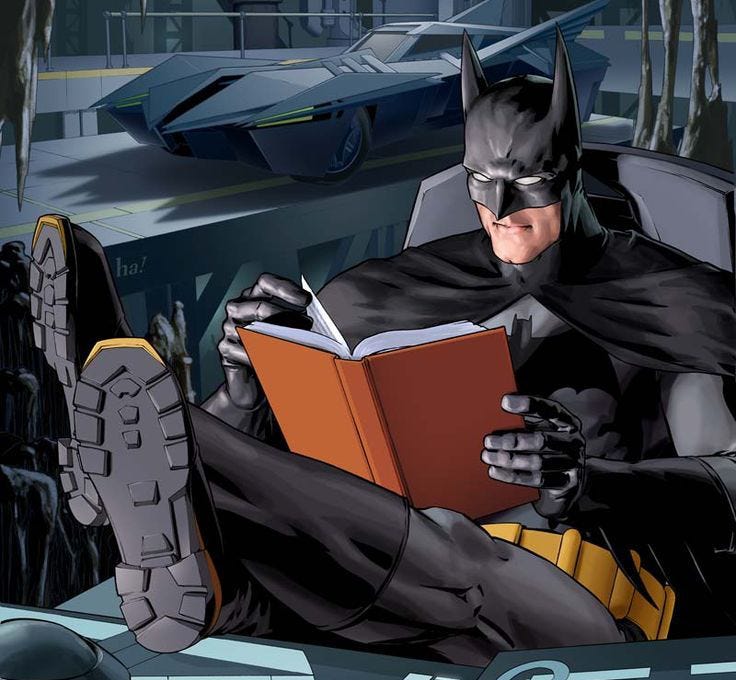
We live in the stories we tell ourselves. — Grant Morrison
As powerful self and worldmaking tools, stories matter. That is why the matter of storytelling extends beyond the stories themselves. It matters how we tell them, who tells them, and who decides which ones to tell. Just as it matters who gets powerful, becomes empowered, through their telling. Or at least it should do.
Storytelling in the Global North is centered around the experiences, imaginations, and desires of white men, primarily straight white men. It represents our world as they see it, live it, and dream it. And ultimately as they have wrought it. When thinking about some of our most beloved stories and protagonists, some meanings and interpretations are privileged and prized too. Batman’s typecasting as a “Dark Knight” is a prime example. Even though Batman’s meaning is always in flux, we have, to date at least, settled on — and to my mind, settled for — a reduced version of the character. Not for the first time have we been seduced by the idea of a Byronic hero with a death wish: misglad, bad, and dangerous to know. (“We,” of course, encompasses creators and audiences and their intersections.) It didn’t have to be this way.
I have talked previously about how prevalent the concept of vengeance and (street) justice is in modern film. But we can easily find its expression in other storytelling forms. Listening to Jimi Hendrix’s cover of Hey Joe — a song about a vengeful man shooting and killing a female partner suspected of being unfaithful — I was again reminded of how often the doings of empowered, agentic women serve as foils for retributive male action. Or as some would say, dishonorable, disobedient, willful women. And how commonplace it is for (overwhelmingly sexualized) violence against women and/or a heterosexual family unit to supply a ready excuse for retributive male violence, often — although perhaps not in Joe’s case — falling into the realm of heroism.
Interlude — The Refrigerator Monologues: A Case Story
Despite increasing awareness and resistance to this misogynistic trope, gender-based violence, frequently sexualized, still routinely serves to provide an emotional backstory, often transformative, for male characters. There’s even a term for it, “fridging.”1 Drawn from the superhero comics world, fridging speaks directly to storytelling traditions utilizing female characters only as a (grizzly) means to an (heroic) end.
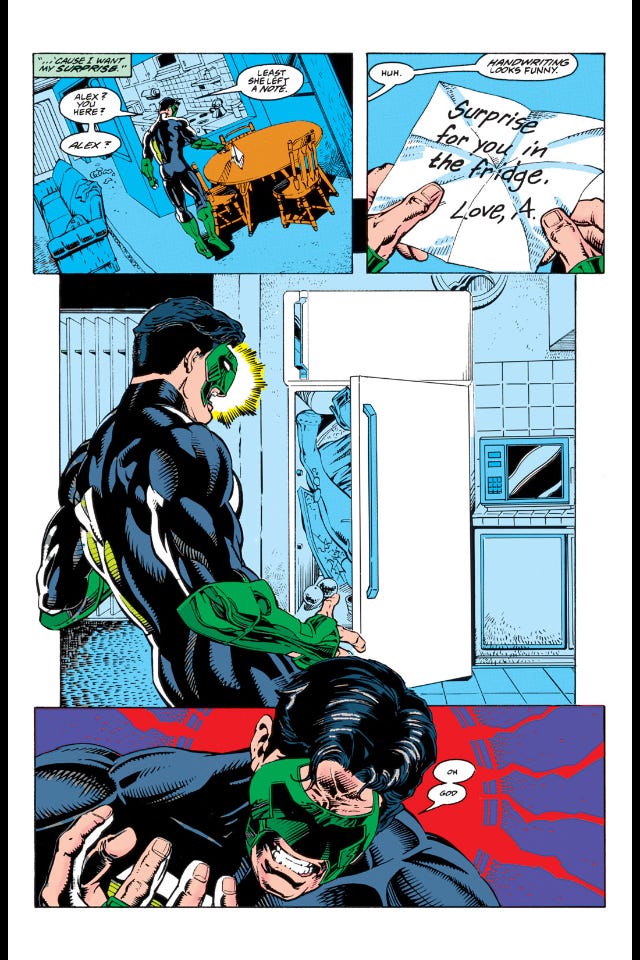
But that’s not all. You see, the issue with fridging isn’t just the brutalizing erasure of the female character in question; it’s that her story, her whole existence, is seen to have value only in so far as it serves another — male — character’s story. Women are reduced to objectified plot devices.
In Frank Miller’s Sin City comics series, Goldie’s murder sets Marv on his vengeful killing spree. The savage murder of Frank Castle’s wife and children unleashes the retributive Punisher upon the world — a name that says it all. And the rape and murder of Becky Butcher by a superhero known as The Homelander underpins Billy Butcher’s vendetta against superheroes (The Boys comics series, also picked up by Amazon Studios). Another character whose name screams out his approach to vengeance. A (damaged) man laboring under a traumatizing character trait, one that — in his world, as in ours — is not disciplined but valorized and empowering, earning him a leading role within a governmental agency (CIA Black Ops team). Characters are fridged in Batman stories too, most notably his parents, Thomas and Martha Wayne. But also, the murder of his one-true love, Rachel Dawes in Christopher Nolan’s Batman trilogy (2005-2012) or Silver St. Cloud in Kevin Smith, Walter Flanagan, Art Thibert, Art Lyon, and Jared Fletcher's Batman: The Widening Gyre. “Super” men driven and inspired to extraordinary levels of action and valor by dint of sexual and gender (and sometimes family) based violence and dishonor. A most curious stimulus, you’d have to agree.
Marv, Frank, Billy, and Bruce, all unexceptional exemplars of this clichéd, chauvinistic motif in action. Catherynne Valente’s superhero novella, The Refrigerator Monologues proves, however, an exceptional example.
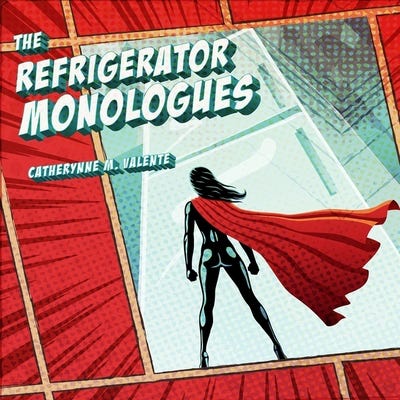
With art provided by Annie Wu, Valente confronts the fridging trope head-on. The story innovatively reimagines the role of women in superhero comics by centering and exploring the lives and deaths of six “fridged” women, each a parody of a popular DC Comics and Marvel Comics character.2 Gwen Stacey from the Spider-Man mythos, for instance, provides the template for Paige Embry. Though murdered, maltreated, and gravely dishonored, the female characters do not, in Valente’s hands, seek the usual cold comfort of violent payback but the cathartic warmth of mutual support and camaraderie.
Fridging is a dehumanizing process, depriving one persona of their individuality by subordinating them, and their story, to another’s. Female characters, here, become non-subjects, non-agents — mere things. The Refrigerator Monologues upends this dire tradition. By centralizing storytelling as a shared survival strategy — the women disclose their life stories to each other at nightly meetings of the “Hell Hath Club” — Valente gives these ordinarily sidelined characters center stage, an attentive audience, and, obviously, their voice. The novel’s structuring mirrors this “showcase” setup: each chapter is dedicated to the story of one character and is written from a first-person narrative point of view, the most immediate, intimate mode of narration. We, the readers, form part of the witness-bearing audience, affiliate members of the “Hell Hath Club.”
By equal measure, language is a tool of domination and of liberation. Words can help change perceptions of the self, the world, and one’s place, or role, within it. The world, according to ethnobotanist and psychedelic guru Terence McKenna, is “made of words” and once you know the language of the world “you can make it whatever you wish.” The generative power of language is well understood and exploited by superhero storytellers too, not least in the matter of transformation — just think of Billy Batson and the transformative power of his magic word “SHAZAM!” Or Zatanna Zatara: As a Homo Magi — a sub-race of humans born with magical abilities — Zatanna is a particularly powerful sorcerer-come-superhero. Her power is linguistic, specifically speaking words and spells backwards. (In effect, reversing and undoing the generative power of man-made language, of disrupting the established order.)
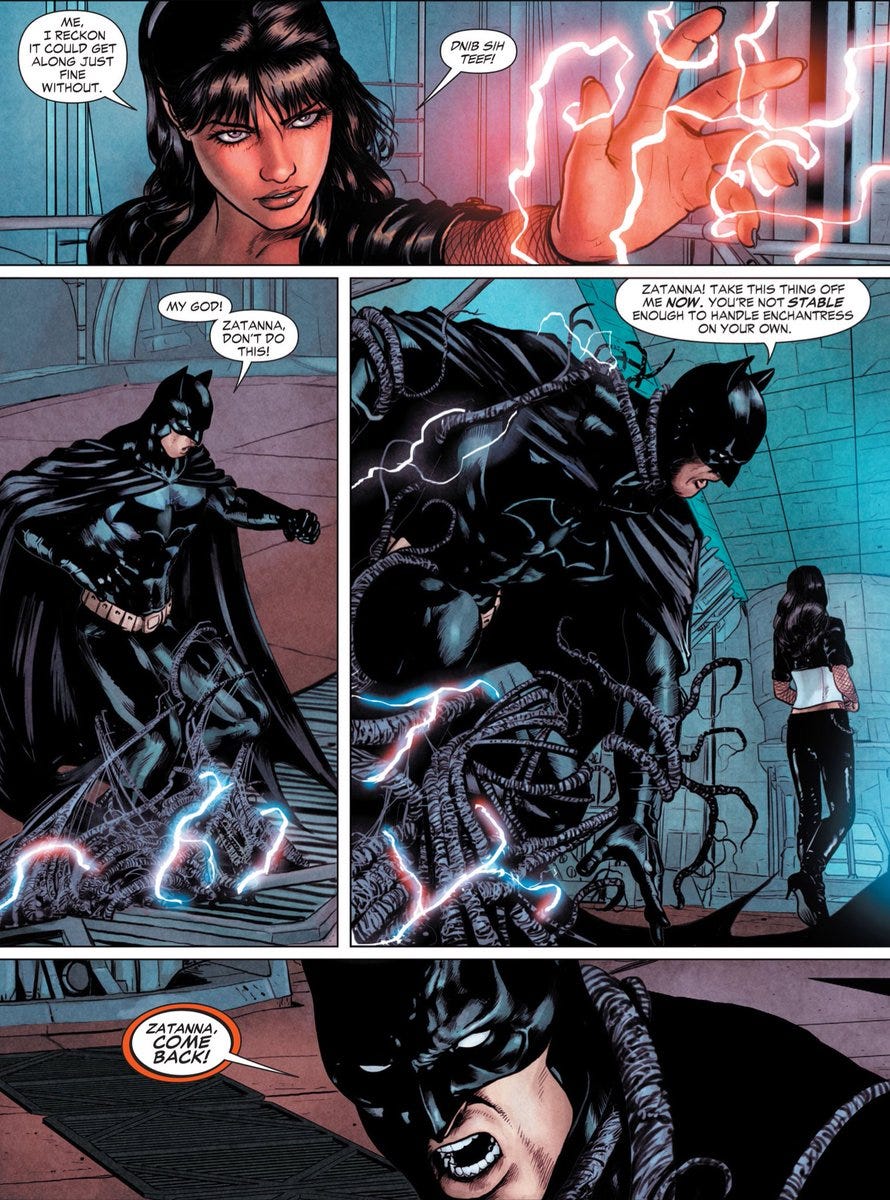
But much like the deadened women inspiring the characters of The Refrigerator Monologues, the most efficient way to disempower her is to silence her. For to take away a voice is to stifle, to repress, to deprive of vitality. Zatanna’s voice is not her only source of power, but it is her aegis. By returning their voices to them, Valente returns life, returns agency to these ghosted characters. Storytelling, after all, is a set of power relations; those who tell the story, control the story. Understanding this — that the way it has been told is the way it will be known and remembered — Valente alters memory and rewrites manmade histories. (Hi)stories all too often pushing hetero-patriarchal notions of love, family, happiness, and honor. In prioritizing same-sex platonic friendship over hetero- romantic/sexual relationships, Valente appears all too aware of the wider gender politics at play here.
Through their raw, retrospective expositions, the female characters disentangle, rescue, their stories from the more prized — official — histories of their abusers, murderers, and “heroic” avengers. We, and they, (re)discover the “who” of them: Who they were — as complex individuals — as opposed to who they were connected to, for they were only ever known to us before as some super-man’s lover, mother, or other kind of significant other. Like Arachne, spinning their words into new yarns, they challenge and resist superhero storytelling traditions, stories about godlike men steeped in heroic portrayals of violence in which women are pawns or prizes.3 A process giving rise to personal agency, a power ordinarily denied female characters, of all kinds. It is empowering, liberatory work. And like all good superhero storytelling, it is transformational. Their storytelling moves them from the margins to the center, melting away the frigid roles and worlds male imaginations have made for them. It is not simply a refusal of the malestream narratives told about them, it is a rebuttal. In Hell’s radiating heat, they are where they should be, at the center, the warm heart of the world.
Just like Valente’s novel, their stories are outside official superhero discourse. (Superhero texts are usually visual — comics, games, films — not prose narratives.) Removed from the constraints and oppressions of a male-dominated genre, they — Valente and her characters — disrupt and repel objectifying and effacing storytelling conventions, creating a much-needed space for women’s voices. As stories from the margins, they reframe female characterization within the superhero genre, certainly, but they also undermine the ever-popular “revenge as motivation” trope.
In dealing with the brutalizing consequences of revenge, their stories remain tragedies of blood, but in reimagining their reactions, these women orators break the closed cycle of retribution. It is not by chance, however, that women created this reformative “revenge” story. Valente could have exacted her own petite vengeance upon a misogynistic genre and a creative industry by telling a furious tale about unforgiving women rising from the dead to inflict violent retribution upon the men who abused and defamed them. And undoubtedly a tale about six hellraising vengeful women would have been hugely popular — as Monster (2003), Kill Bill (2003), and Lady Vengeance (2005) attest — especially perhaps today given the current interest in “woman-of-action” revenge stories, such as Peppermint (2018) and Marvel Studios’ Black Widow (2021). But she didn’t. Valente instead chose to productively engage the onerous trope — to provoke a dialogue — rather than replicate it.
My silences had not protected me. Your silence will not protect you. But for every real word spoken, for every attempt I had ever made to speak those truths for which I am still seeking, I had made contact with other women while we examined the words to fit a world in which we all believed, bridging our differences. — Audre Lorde
In illuminating the connective, transformative power of sharing experiences and stories, Valente presents another way of responding to wrongdoing. A mature, productive, love-centric approach cultivating engaged empathy, connection, healing, personal growth, and hope, and thus solidarity, resistance, activism, and change. There is anger too, certainly, though it is of the more generative than (self)destructive kind. As we see in real-world global movements against sexual abuse, assault, and harassment, such as #MeToo, sharing stories can be empowering; it can reveal the prevalence of gender-based violence, often systemic, and nurture solidarity and change. Silence, as Audre Lorde observed, will not protect us. Moreover, Valente, here, bypasses the binary frameworks dominating androcentric stories and storytelling showing that our approach to justice doesn’t have to be one thing or another, in this case, anger or forgiveness, revenge or amnesty, hate or amity — it can be a dynamic mix of both. Despite its prevalence in male-centered worlds, retributive justice is not our only response to abuse and violence (physical, sexual, psychological). Other kinds of justice, such as restorative, offer the possibilities of disrupting, escaping, and erasing cycles of abuse and violence. Valente saw the possibilities of moving beyond old ways of doing things, rather than simply repeating them. Reeves didn’t or couldn’t.
A dream of dark and troubling things. — David Lynch
As observed in Part One of this essay, Reeves will not be the one to wake Batman, and us, from his long, dark nightmare. A grim fate made even more so because there were other paths Reeves could have taken. Not only other Batman tales to be told but another way of telling the Batman story. Batman is amongst our most problematic yet beloved heroes and doubtlessly beloved because of the very traits that make him problematic. And wishing him to be made decent, to be made good — like another little fiery-eyed avenger, Heathcliff — it is just another dream, like wishing him away. But his storytellers could be radically retexturizing his story to allow it to speak directly and meaningfully to the condition of our times.
The Batman mythos, after all, possesses — in its portrayal of (social and personal) transformation, vengeance, (street) justice, white privilege, (“philanthropic”) dynastic wealth, and predatory capitalism to name just a few themes — deep relevance to the on-going intertwining quest for social, racial, and economic justice. In this most recent retelling, we could have had a film finally taking seriously the responsibility of representing white male vigilante justice, one underscoring its dangers rather than its agentic delights. An interpretation accounting for America’s long and baneful history of white male vigilantism and street justice, as well as its heroization. And its official face: policing institutions. Imagine: A Batman story radically confronting matters of street justice and “warrior mentality” policing;4 perennial issues, but ones rising to the fore again in the aftermath of the brutalization and murder of Black people by police and white citizens emboldened by the “Blue Line” fraternity.5
The teaser trailer, and subsequent trailers and paratexts, inform us this is not to be.
And in passing, to those who would say that the filmmakers couldn’t have made a more radical Batman film because they couldn’t have known the condition the US would be in when the project started (Reeves took charge in 2017), I would simply say that life in the US — a colonizing nation founded on genocide and chattel enslavement — has always been like this, created through a “domination/ subordination” system, albeit not always so exposed. There have always been grim-faced, imperious, vengeful white men — heroes of the community — patrolling neighborhoods to keep them “safe.” It has then always been entirely possible to conceive of different kinds of Batman stories but not so eminently desirable to produce them.
Yet, in many ways, Reeves is telling the story of our times: a privileged yet fearful white man fights to steer, to shape, to control the world around him through fear and violence. To protect “us” from “them.” As Ian Bremmer writes: “Depending on who’s talking, ‘them’ can mean the corrupt elite or the grasping poor; foreigners or members of racial, ethnic, or religious minorities. Or disloyal politicians, bureaucrats, bankers or judges. Or lying reporters.” In short, to protect “good” people from “bad” people, as is Batman’s want. One man with power enough to un/make the world as he wishes, a not unfamiliar protagonist or tale. For historically these kinds of men and narratives have formed our world; how we inhabit it and imagine it, in all spheres, from our homes to our homelands. (Just look at Vladimir Putin’s, President of Russia, decision to invade Ukraine.) Ask descendants of colonized peoples and lands. Ask women and children suffering domestic violence and abuse. Ask people demanding economic, racial, social, end environmental justice, all entwining threads of resistance and revolution. They — we — feel the fecund power of dominant narratives, white supremacist capitalist patriarchy, as bell hooks memorably described it, with, I would add, a dash of religion for extra mastery.
Aspects of heroism too have been weaponized in our grand narratives, the idea that people need someone, some “great man,” to protect them, to save them, and that violence is somehow key to this “saving.” Our histories — cultural, intellectual, political — abound with stories sanitizing binary notions of leaders and followers, the powerful and powerless, and agents of change and “blind fools of fate”; that where we are weak, fearful, and ordinary, “he” is strong, courageous, extraordinary. Despite their disempowering possibilities, (super)hero stories are much beloved and going nowhere fast. (Look at the speed with which much of the world heroized Volodymyr Zelenskyy, President of currently embattled Ukraine, perhaps forgetting that when we raise individuals up, we centralize our power and make easy targets of those uplifted.) Not only can heroes inspire and motivate folks to action, but some people find themselves relating to heroic protagonists and in some cases emulating their “heroic” actions. (Remember Alan Moore’s, “I am Rorschach” guy!) And herein lies the rub, particularly with the Batman story and the macho vigilante genre more broadly.
It is Batman’s deep-rooted connection to patriarchal honor codes plus his vigilantism and conservatism — state authority is incompetent/untrustworthy and thus as a rich individual it is his duty to step in and, under the guise of making the world a better, safer place, protect the status quo — that means his representation, his story, must always, but especially today, be handled with great care, lest he becomes even more of a poster-boy, a hero, for real-world vigilantes (including men and boys manifesting what Charles M. Blow described as, “reactionary white male victimization syndrome”), populists, and the alt-right, as has happened with the Punisher and the villainous Bane. But Batman is a major cultural icon with global reach. Resonating far beyond superhero and comics fan domains, his story offers a particularly powerful opportunity to meaningfully engage and critique concepts such as heroism, vengeance, vigilantism, retributive justice in the popular imagination. An opportunity lost now, at least in terms of the next decade or so of mainstream filmmaking.
It was 2005 when Ra’s Al Ghul told a questing Bruce Wayne that whatever his original intentions, he had become truly lost (Batman Begins). And in that storyline, it was Ra’s Al Ghul who manipulated Bruce’s childhood trauma, his desire for justice and peace, and his wish to make the world a safer, better place, and ultimately though inadvertently, it was Ra’s Al Ghul who set him on the path to becoming the “Dark Knight.” Of course, that’s just a superhero story. But it mirrors the creative treatment, or exploitation, of the character too.
Over the decades, many creators, like Ra’s Al Ghul, have had the opportunity to set Bruce on a path to becoming something more than a vigilante, to becoming a different kind of legend or hero. And, again like Ra’s Al Ghul, many creators have exploited the character’s trauma, vengefulness, and sense of civic responsibility to make him into a “Dark Knight” rather than setting him on a path towards finding another way to name, face, and survive his childhood trauma and thus leave a different kind of mark on the world. But like Reeves and Christopher Nolan before him, they — and those invested in the superhero industry, including fans — simply couldn’t imagine it.
And so, some seventeen years after Ra’s Al Ghul invited Bruce to the top of a frigid mountain, we see another emotionally frozen Bruce, once again at the precipice of becoming, but a becoming predestined, a becoming already become: To the question, “Who the hell are you supposed to be?” the new Bruce doesn’t answer, as is usual in these circumstance, “I’m Batman” but rather responds, “I’m vengeance,” a hard-hitting response punctuated with, well, some hard-hitting punches.
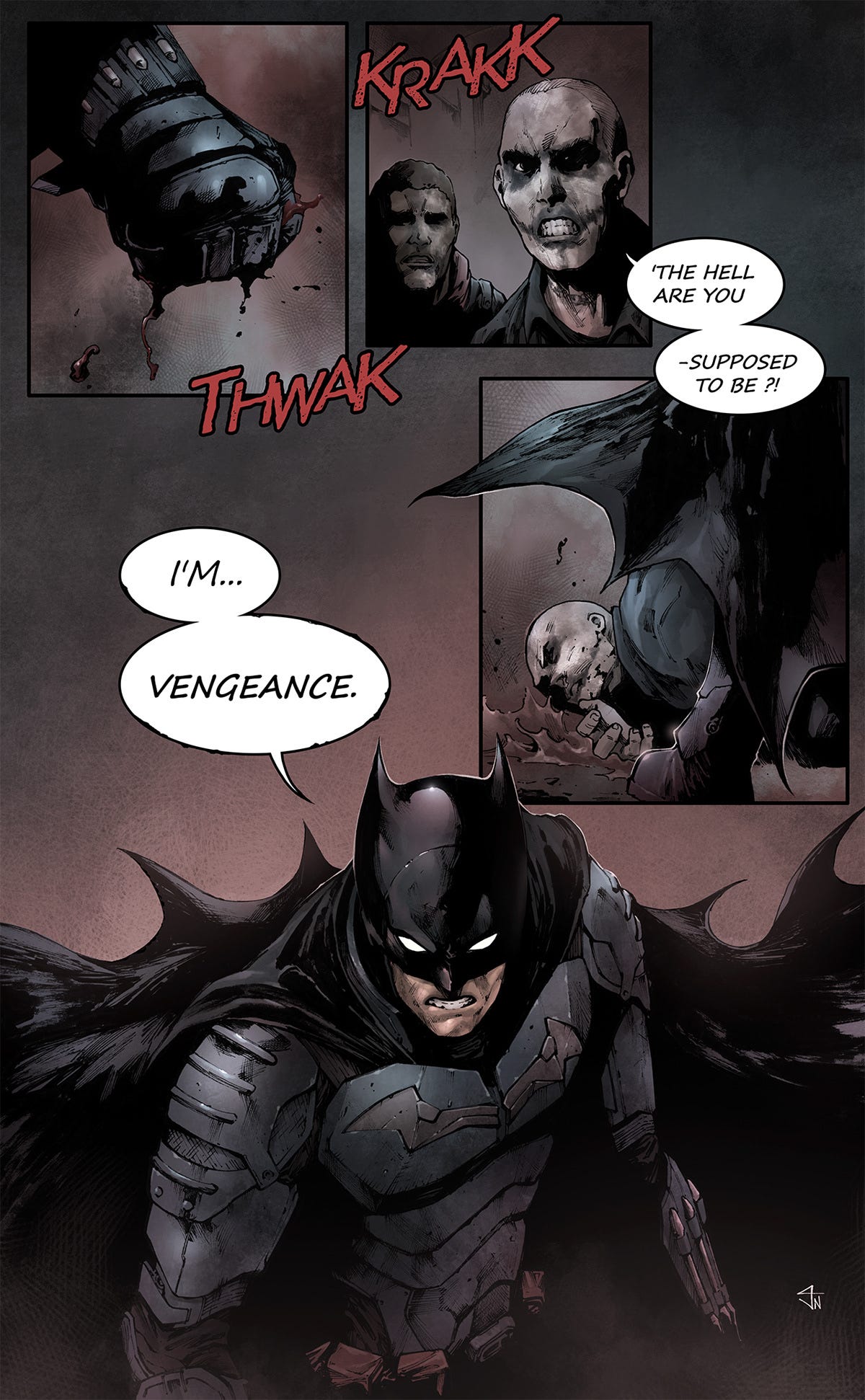
This small statement tells us all we need to know about the new Batman characterization; there is no process of becoming for this new Bruce, nor pretense of process, no first becoming Batman then morphing somewhere along the way into the “Dark Knight.” It is the illusion of becoming, of choice, of creativity, of progress, of “any color as long as its black,” of a new Batman story as long as it features the legendary “Dark Knight.”
As is well documented, stories matter. We need and deserve, and indeed can have, better superhero stories. The superhero genre is part of a rich speculative, futurist tradition, and our superhero creators should be tapping into that potential to tell stories that help us to critique and to radically reimagine our world. (And not simply upcycling stories, characters, and costumes.) As I’ve written elsewhere, I’m not so sure of the value of heroes and of stories about heroes, but if we are to have them, then let them be free from the furious shadow of malestream imaginings.
If you enjoyed this essay, please share:
Or subscribe:
Thank You!
In March 1999, feminist comics creator Gail Simone created a website — Women in Refrigerators — in response to her observation that it wasn’t “healthy to be a female character in comics.” The digital archive includes over one hundred female superheroes, including A-list female characters, who have been “depowered, raped, or cut up and stuck in the refrigerator.” Simone’s cultural reference point is an episode in a Green Lantern (#54, 1994) storyline in which the hero finds his murdered and disjointed girlfriend stuffed into his refrigerator. Hence, fridging. The term has since jumped from the superhero comics world and is now used widely within broader pop culture criticism. See also, https://the-artifice.com/women-in-refrigerators-killing-females-in-comics/
The novella was picked up by Amazon Studios in 2018 and is currently being adapted for TV as the female-centric superhero series, Deadtown.
Briefly, (mortal) Arachne beat (god) Athena in a weaving competition and was turned into a spider. Unlike Athena, Arachne used her spinning and weaving skills to create a tapestry to tell a (counter)story about the nature of the gods focusing specifically on stories in which male gods sexually assaulted female mortals. Arachne’s bold counterstorytelling provoked Athena into a vengeful rage and she transformed Arachne literally into a Spider-Woman. For a fun recap of the story, see: The Myth of Arachne – Iseult Gillespie.
For example, see: The End of Policing by Alex S. Vitale; 13th (2016, dir. Ava DuVernay ); I Am Not Your Negro (2016, dir. Raoul Peck).
An informal brotherhood comprising active and ex- officers, on- and off- duty officers, family members, and even friends of cops.