

Ripley: The Grey Perspective, in Notes
A brief exploration of the greyscale world of Netflix’s Ripley, where identity blurs, class shapes perception, and ambiguity offers a form of freedom.
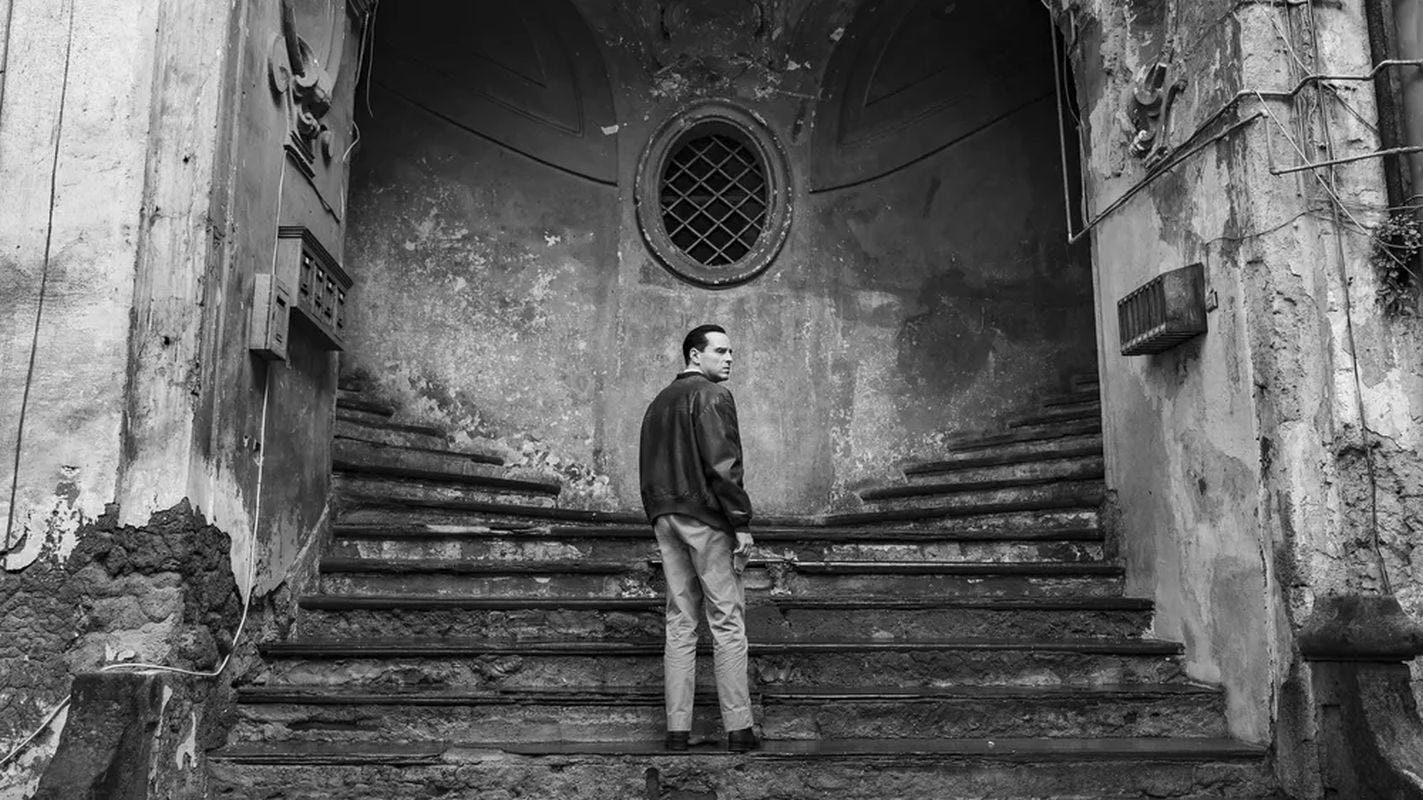
“Everything about Tom is perfectly vague,” Marge says in Ripley. A word that means formless, obscure, shadowed, and, arguably, grey. Fitting for a series about a murderous identity thief, shot entirely in black and white, or more precisely, in an astonishing range of greys made possible by modern cameras’ ability to capture subtle shifts in light. The palette becomes a way of showing not just how things look but how they feel, revealing the texture of a world seen through Tom Ripley’s eyes. A name that suggests its own motion: Ripley, always rippling outward, disturbing the surface. The show is committed to his perspective, echoing Patricia Highsmith’s 1955 novel, which director Steven Zaillian set out to recreate faithfully. And in a coincidental loop, the show’s noir-inspired aesthetic mirrors the story’s own beginnings: black ink on a white page, a world that turns grey only as we read it.
Vague. Tom lives in the grey because the world he comes from offers no other palette. The show’s monochromatic look doesn’t just mirror his personality; it captures the condition of people who move through life without the protections of class, certainty, or sanctioned identity. “A hard man to find,” the PI says, and harder still to pin down. A nocturnal creature navigating the grey economy, the terrain of the working poor, where nothing is wasted and nothing is fixed. Tom’s ambiguity – moral, sexual, social – is less a personal quirk than a survival strategy. His fluidity is a response to a world that denies him solidity. Tom moves in shadow because shadow is where people without power are expected to remain. But as his later encounter with “art dealer” Reeves Minot shows, the shadows can also be liberating, offering a kind of freedom from the social norms and conventions that bind everyone else. A vague trade, much like Tom’s and Reeves’ identity play, dealing in representations of reality – fakes, copies, versions of the world – exposing how fragile the idea of “reality” really is.
Vague. It isn’t an ugly world; Zaillian finds beauty in the grey. It brought to mind Wings of Desire, Wim Wenders’ tale of an angel aching to descend into human experience. If that film dreams of a heavenly figure longing to fall, Tom is its grim inversion, a devil already walking among us. And everywhere he goes, there are steps – endless steps – rising and falling through Atrani and Naples, an age-old architecture of social stratification. Some people ascend them without noticing; others, like Tom, climb them with difficulty because they must, a reminder that in this world status is never fixed, only ascending or slipping away.
Vague. As if their world – hers and Dickie’s – were solid, definite, unquestioned. She said it like an accusation. But weren’t they all, in their own ways, struggling with who they were supposed to be? Just like Tom, they used versions of their names, slipping between selves. Dickie, Richard to his parents. Marge, surely Margaret at home. Freddie, and so on. The show is steeped in a kind of unspoken “fake it till you make it,” though Tom takes the idea to its most dangerous extreme. Everyone is performing something. Even Marge, when she insists she’s a writer, is trying to speak a version of herself into existence. Dickie performs ease, Freddie performs bravado, the parents perform respectability. They might presume the certainty of a black‑and‑white world, but like Tom, they can’t escape the truth that life unfolds in shades: not only grey, but, for some, in full, blazing colour. A spectrum, after all, offers no more clarity than monochrome; its richness only multiplies the ways life resists being pinned down, deepening the sense that it won’t stay still.
Vague. We never see Dickie’s set the way they see themselves. We see them only as Tom does; and as Marge reminds us, everything about Tom, including them now, is perfectly vague, washed into a kind of grey. It makes me wonder how they see him in return. Marge, I suspect, sees him in muted greys; she is, after all, the story’s literal doubting Thomas, forever questioning, forever uncertain. Dickie, by contrast, moves through a world saturated with colour; his world, and to an extent Marge’s, is bright with the Tyrrhenian Sea’s emerald-blue sparkle, Picasso’s yellows, the soft, caramel of his Ferragamo’s, the reddish-amber warmth of a Negroni. A world of prismatic lightness. Because make no mistake, those around Dickie move through a world far more colourful than Tom ever could; even when he’s living as Dickie, everything stays stubbornly grey for him. A difference in perspective, born, I suspect, of the very different worlds that made them. Flamingos turn pink because of what they consume, and the rich are no different: they absorb brightness from the ease, beauty, and assurance that tomorrow will resemble today. Their worries never touch survival. Tom, meanwhile, feeds on scarcity, vigilance, and the constant need to adapt. His palette stays muted because his life demands it.
But the grey is not merely deprivation; it is also a way of seeing. Zaillian renders it as a space where boundaries soften and categories lose their authority, where survival depends on reading nuance rather than clinging to absolutes. It’s a worldview that refuses the comfort of moral crispness – the comfort many viewers still crave – and instead recognises that most of life happens in the in‑between. In this light, the grey is not Tom’s private terrain but a shared human condition, a reminder that certainty is a fiction and that we live, always, on moving ground.
Thanks for reading The Break! Support my work by subscribing and sharing it with others — it makes a huge difference. And if you want to go the extra mile, you can become one of those truly special people who support my writing for the price of a couple of coffees each month.